Manoushe
The Lebanese Flatbread That Rose from Village Ovens to the World Stage

By Lina Saad
There are foods that nourish, and there are foods that carry memory.
The Lebanese manoushe belongs to the latter.
For many Lebanese people, manoushe is far more than a breakfast pastry. It is the scent of za’atar drifting from the neighbourhood bakery at dawn. It is the warmth of paper-wrapped bread balanced in a child’s hands on the walk home. It is family gathered around a breakfast table layered with olives, mint, tomatoes and sweet tea. It is tradition pressed into dough with the fingertips.
Today, manoushe (plural manaquish) has travelled far beyond the village bakeries of Lebanon. Once a humble flatbread eaten in homes and at local furns, it now appears in stylish bakeries from Beirut to Dubai, from London to New York. It has evolved from rustic dough topped simply with za’atar and olive oil into artisan sourdough creations served in some of the world’s most celebrated Middle Eastern kitchens.
Yet despite its modern reinvention, the essence of manoushe remains unchanged: it is bread shaped by culture, by ritual, and by the quiet poetry of everyday life.
The story of manoushe begins long before Lebanon itself. Bread-making traces back to ancient Egypt, where the first leavened breads were developed using wild fermentation. The Romans later adopted these methods, producing various forms of flatbread dressed with herbs and oil. Across the eastern Mediterranean, these breads evolved according to local ingredients and customs, becoming the foundation for countless regional specialties, from Italian focaccia to Levantine village breads. Lebanon’s manoushe belongs to this ancient lineage, but it developed its own identity.
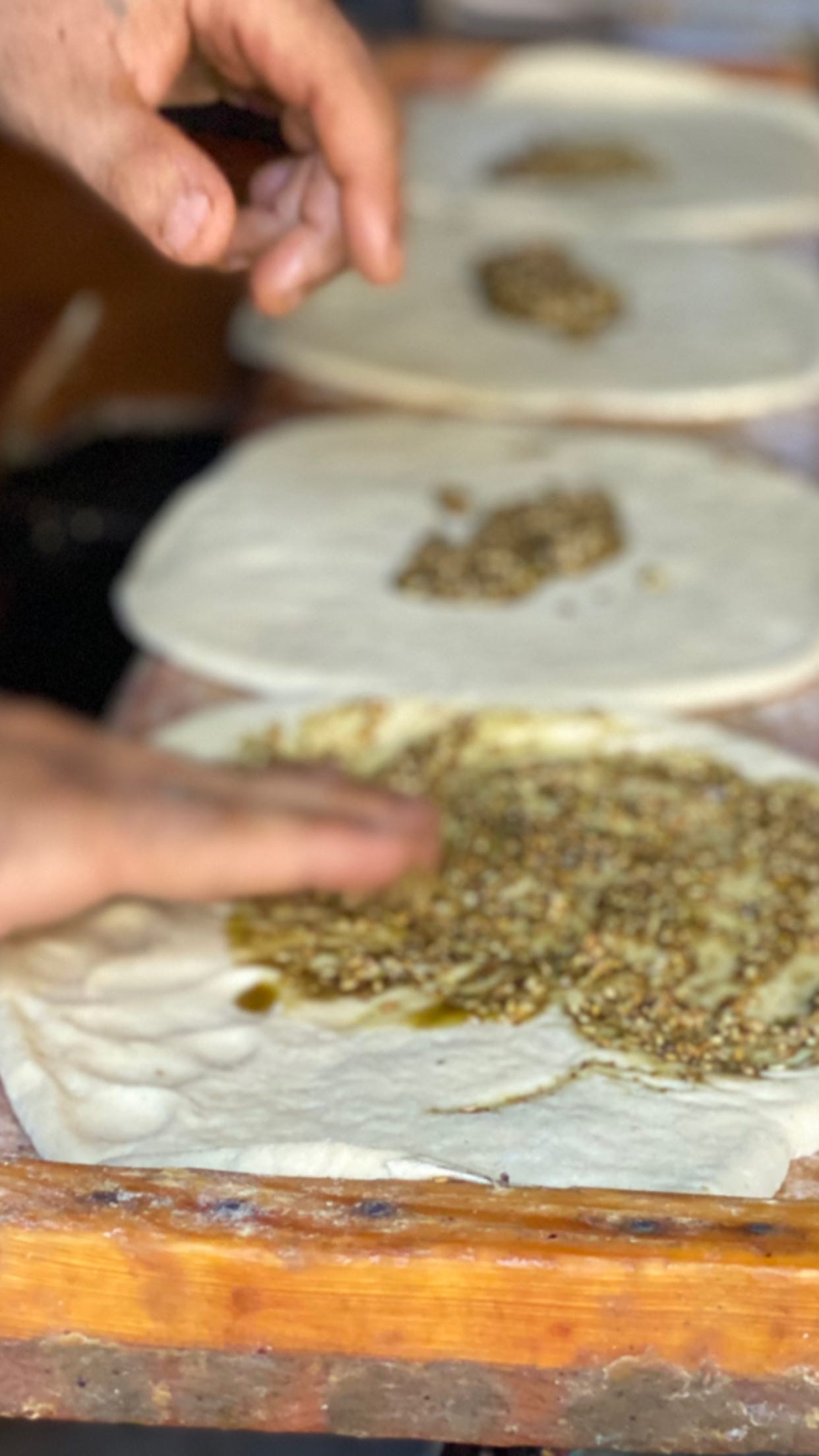
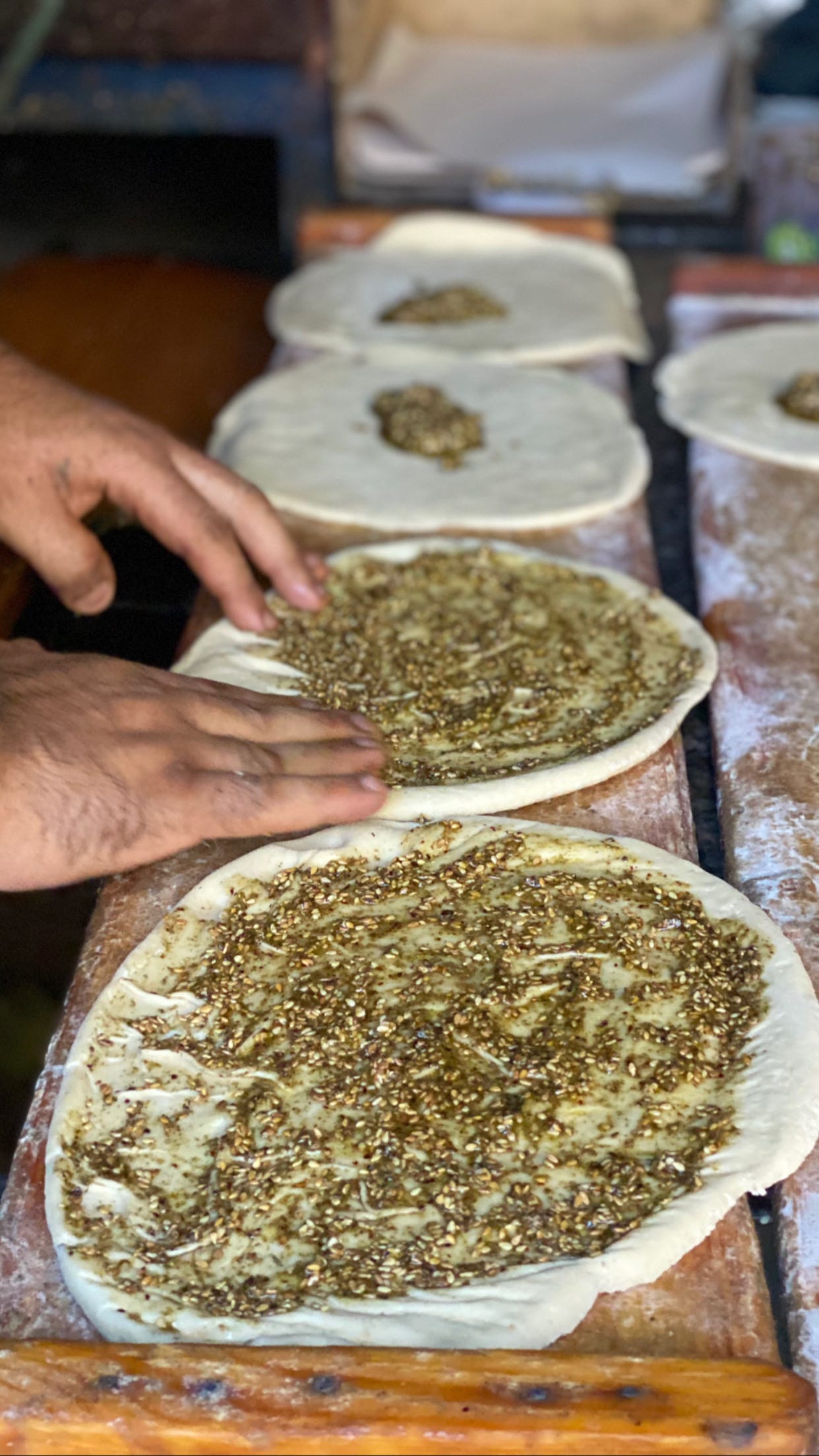
Unlike focaccia, whose long fermentation creates a thick, airy crumb, manoushe is traditionally made with a softer, flatter dough intended for quick baking in communal wood-fired ovens. Its name is thought to derive from the Arabic verb na’asha, meaning “to engrave” or “to decorate,” referring to the way bakers press the dough with their fingertips before adding toppings.
This pressing is more than practical, it is symbolic.
Five fingers sink lightly into the dough, creating shallow indentations that hold the topping in place and encourage gentle bubbling in the oven. This tactile motion, repeated across generations, is one of the defining gestures of Lebanese baking.
“If dough is the body of the manoushe, then za’atar is its soul.”
The classic topping begins with dried wild thyme, often Syrian oregano, ground finely and blended with sesame seeds, sumac, and salt. Mixed with olive oil into a fragrant paste, it is spread over the dough before baking. The aroma is unmistakable: earthy, citrusy, nutty and warm.
It is the scent of Lebanese mornings.
Though every household has its own ratio, the essential character remains the same. Some families enrich their za’atar with fennel seeds, pistachios, or marjoram depending on regional traditions, but the classic blend speaks of simplicity and heritage.
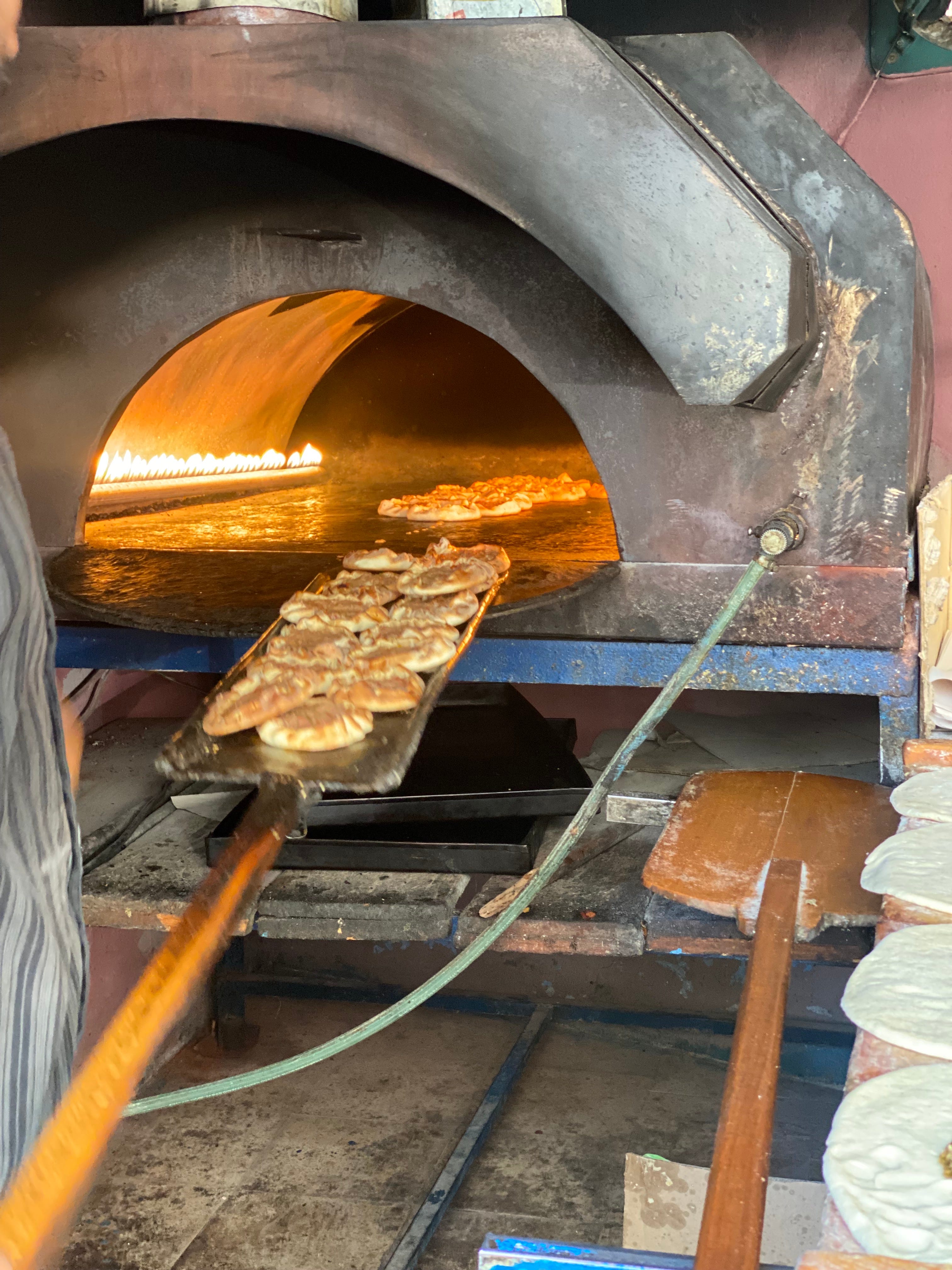
Once baked in a wood-fired oven, the za’atar topping darkens slightly, releasing oils that perfume the bread. The edges become gently crisp while the centre stays soft and pliable, ideal for folding around fresh vegetables, olives, and mint.
This is the quintessential Lebanese breakfast: manoushe za’atar rolled with cucumber, tomato, olives, fresh mint and spring onions, served with black tea sweetened generously with sugar. It is modest food, yet deeply luxurious in memory.
Beyond za’atar, the cheese manoushe holds an equally beloved place in Lebanese households.Traditionally, the cheese of choice is akkawi; a soft, brined white cheese soaked overnight to reduce its saltiness. Crumbled or sliced onto the dough, then dotted with butter and sprinkled with sesame or poppy seeds, it melts into a rich, savoury topping that is unmistakably Lebanese. For many families, preparing cheese manoushe is a ritual.
Children were sent to the local furn carrying tubs of toppings prepared at home: one bowl of za’atar, another of cheese, butter on the side, and perhaps sesame seeds in a small paper packet. The baker would provide rounds of freshly prepared dough laid out on wooden boards, and the family would assemble each manoushe by hand before passing it back to the baker for the oven. Minutes later, they would be returned warm, fragrant, and wrapped in newspaper.
It was communal, practical, and deeply personal.
Then there was kishk manoushe, a treasured village variation. Kishk, a fermented mixture of yoghurt and cracked wheat dried into powder, was blended with chopped tomatoes, onions, sesame seeds, oil and a touch of chilli before being spread over the dough.
The result was intensely savoury, tangy, and deeply satisfying.
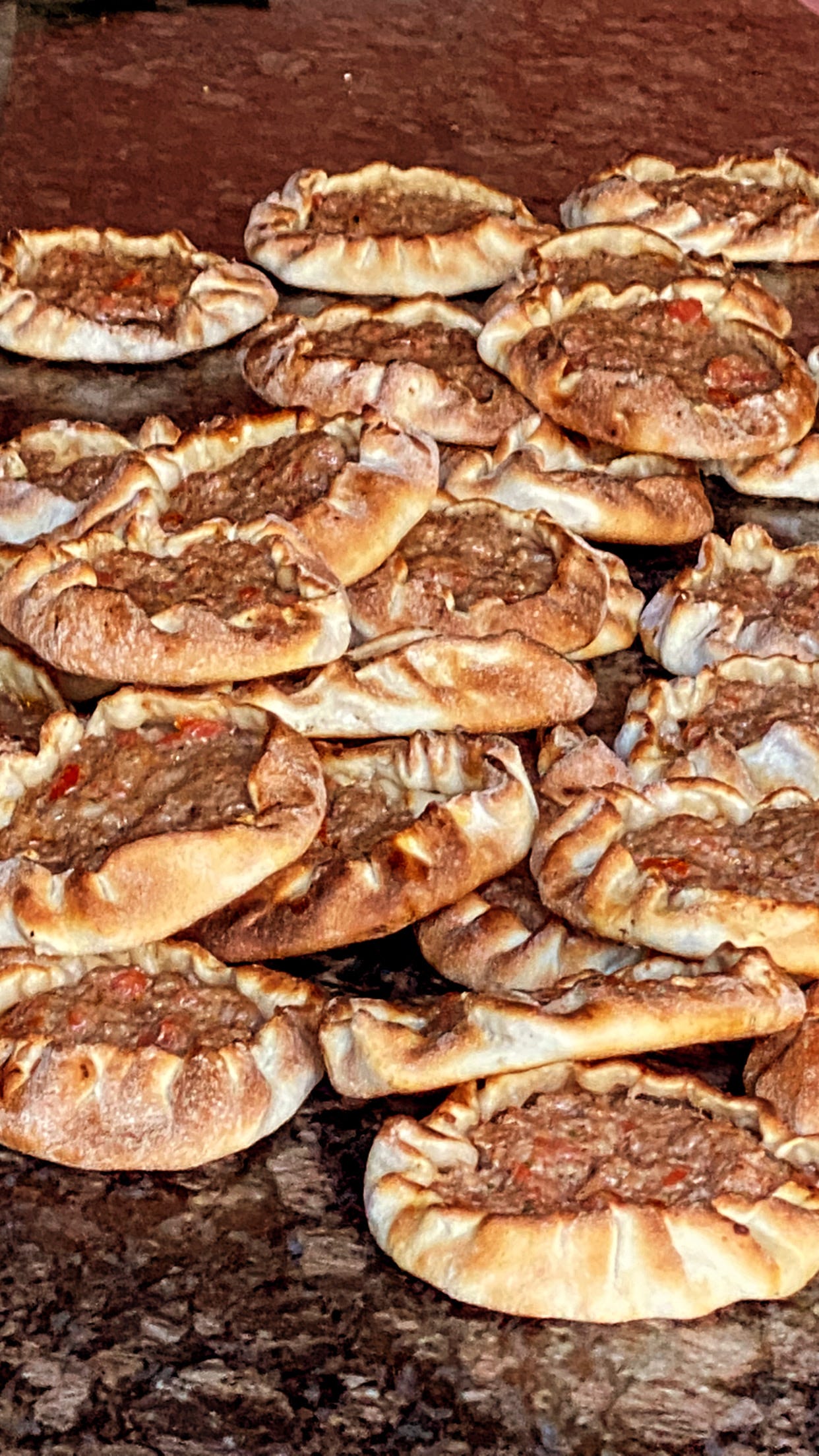
There were also cocktail manaquish, half cheese and half za’atar, offering the best of both worlds. For lunch, families might prepare lahm bi ajeen, topped with minced lamb, tomatoes and onions; a richer, heartier counterpart to the breakfast versions. These were not merely menu options. They were expressions of family rhythm and daily life.
For Lebanese people, manoushe is inseparable from memory.
It is the bakery queue on a Beirut morning.
It is the crackle of newspaper around hot bread.
It is the walk back home trying not to tear off a piece before arriving.
It is also the countryside.
Many of the strongest memories tied to manoushe are rural: mornings on village balconies, the smell of wood smoke in the air, the garden’s fresh mint just picked, ripe tomatoes sliced on the table, olives brought from the pantry, and a hot manoushe za’atar folded into a wrap and eaten slowly with sweet tea. These moments define the emotional landscape of Lebanese food.
They are not extravagant meals, yet they are abundant in the ways that matter, abundant in ritual, generosity and belonging. That is why manoushe endures. It feeds memory as much as hunger.
Over the past few decades, manoushe has moved from village bakeries into the global culinary spotlight.
As Lebanese communities migrated, they carried their food traditions with them. Bakeries in London, Paris, Dubai, Sydney and New York began producing manaquish for expatriates longing for the flavours of home. Slowly, the dish entered the wider food culture, appreciated not only as a nostalgic staple but as a refined culinary offering.
Today, some of the most fashionable Middle Eastern restaurants serve manoushe made with naturally leavened sourdough, topped with artisan cheeses, heritage za’atar blends, or elevated seasonal ingredients.
This reinvention has introduced manoushe to a new audience.
Yet it raises an interesting tension: how does a humble working bread retain its soul when placed on a designer plate?
The answer lies in the integrity of its origins.
Whether baked in a London restaurant or a Beirut neighbourhood oven, manoushe remains a bread defined by touch, aroma and sharing. Its elegance lies not in embellishment but in simplicity.
In Lebanon today, manoushe holds another, more complex meaning.
Alongside its joyful associations, it has become a symbol of economic hardship.
As Lebanon has endured financial crisis, manoushe has increasingly become one of the most affordable foods available; a filling, inexpensive meal for families facing economic strain. What was once the breakfast of comfort has also become, for many, the breakfast of necessity.
This duality reflects the resilience of Lebanese cuisine.
Food in Lebanon has always adapted through migration, hardship, celebration and reinvention. Manoush eembodies that resilience. It remains present in times of joy and in times of struggle, continuing to nourish communities with the simplest ingredients: flour, thyme, oil, cheese.
Its accessibility is not a diminishment of its value; it is proof of its cultural strength.
In every Lebanese memory, there is a manoushe.
A child carrying dough trays to the furn.
A baker pressing his fingers into soft dough.
An aunt tearing off warm bread on a village balcony.
The scent of za’atar and wood smoke in the morning air.
These scenes are repeated in countless homes, villages and cities, in Lebanon and across the diaspora.
This is why manoushe has endured while trends come and go.
It is not just a flatbread.
It is a ritual.
It is heritage.
It is home.
And whether served in a rustic village bakery or in an elegant restaurant halfway across the world, manoushe carries with it the same message: that the simplest foods often hold the deepest stories.
In Lebanon, we do not merely eat manoushe.
We inherit it.
And that is why it lives forever.
Yummmmm! I can smell it right now. It’s the best ever! We have such a magnificent cuisine. 😍
This was such a beautiful and meaningful read. I visited Lebanon (on a food-focused trip) in 2011 and one of the things that I found compelling was the complex history of aspects of the cuisine and how much they intersect with people, culture, human history and so much more. Beautiful piece on the manoushe and it’s wider meaning to Lebanese people. Thank you!