Yakhni

A Lebanese Legacy of Nourishment and Love
There is a quiet poetry to Lebanese yakhni, a one-pot stew simmered gently over a flame, layered with love, patience, and the essence of generations. In its most humble form, a yakhni is a dish of vegetables and meat cooked in a seasoned broth, often served with a side of Egyptian rice laced with golden vermicelli.
But to Lebanese families, it is so much more. It is a symbol of identity, a carrier of memory, and the cornerstone of our table.
The word yakhni is believed to have Persian and Turkish roots, stemming from yahni, meaning “stew.” The tradition of slow-cooked dishes travelled through the Levant, and in Lebanon the yakhni evolved into countless regional variations. What defines it here is not just its ingredients, but its seasonality, versatility, and its deep connection to home.
Lebanese women have long prepared tomato-based yakhnis for the colder months; warm, robust and comforting. Their signature lies in the teklayeh (crushed garlic and fresh coriander tossed into sizzling oil at the end of cooking). As the seasons shift, so does the base: yoghurt or lemon replaces tomato, lending the dish a lighter, tangier note. Whether made with okra, green beans (loubieh), peas, potatoes, or molokhieh (Jew’s mallow), yakhnis encapsulate the bounty of our land and the rhythm of family life.
Growing up in Lebanon, I was raised by my grandparents and my beloved Aunt Samia while my parents lived and worked in West Africa. My summers were filled with food, stories, and countryside walks with Samia who was always concerned about my appetite.
I was an impossibly thin, fussy eater, and Samia carried a deep sense of responsibility for my nourishment. One memory stands out: she would prepare Yakhnet Loubieh — green bean yakhni with lamb cubes — and take me on long walks, hoping the fresh air would stir my hunger. One afternoon, she held out a piece of bread topped with the stew to tempt me, only for a clever cow to snatch it straight from her hand. I still remember her laughter and my own bewildered eyes, as the cow stole not just the bread but her hopes for my lunch that day.
Despite my fussiness, I had a soft spot for molokhieh (Jew’s mallow cooked with lamb or chicken), especially the garlicky lamb version. I would always ask for “no bread, just rice and soup” the marqaa, that rich, flavourful broth that escapes the greens. It was my safe comfort.
Yakhnis were also the first real food I ever ate. Like so many Lebanese children, I was weaned from milk with spoonfuls of soft vegetables and rice soaked in stew. That moment marks the beginning of a lifelong relationship with our cuisine, it’s a rite of passage. If you were raised on yakhni, you are unmistakably Lebanese.
Today, I live in London with my own children, and the tradition continues. Our Mondays and Tuesdays are dedicated to yakhnis, each child choosing their favourite. Fridays and Saturdays often follow suit. It’s the ultimate family meal: cooked in one pot, rich in vegetables, protein, and warmth enough to last two days.
As a working mother, I find comfort in its ease and satisfaction in its wholesomeness. My children have grown up on real food. They opted out of school meals by the age of eight, rejecting processed fish fingers, halal chicken nuggets, and sausages. They chose instead the honest flavours of slow-simmered stews, the aroma of onions and spices dancing in olive oil, and the joy of eating food made from scratch.
In every bowl of yakhni, there is history and heritage, a dish that speaks of Lebanese resilience, of matriarchs who measured ingredients with their hearts, and of children whether in a village in Lebanon or a London house growing up nourished by tradition.
The Yakhnis of Lebanon: A Dish for Every Season
Lebanese yakhnis are wonderfully diverse, with each household and region having its own variations. The defining thread that unites them all is the teklayeh, that irresistible toss of garlic and coriander added at the very end, heightening the aroma and flavour of the stew.
• Yakhnet Sabanikh – Spinach cooked with minced lamb and pine nuts, flavoured with lemon, garlic and coriander, served with pilaf rice and extra squeezes of lemon. As a child, I remember picking out the pine nuts on the side, only for my Aunt Samia to eat them and say I was missing out on the best part. “They’re scrumptious and good for your brain!” she’d smile.
• Yakhnet Molokhieh – Slow-cooked Jew’s mallow, a yakhni that made its way from the banks of the Nile to Lebanon, yet is cooked and served completely differently from the Egyptian version. This is one of the most renowned yakhnis in Lebanon, with households often competing over who makes the best one. I still remember my grandmother buying more than twenty bunches of green molokhieh and sitting on the floor to pick the leaves. They would be dried in summer on cotton cloths and packed in canvas bags for winter. The leaves are boiled until tender with lemon juice, then cooked with grilled onion, plenty of garlic, fresh coriander, and a hint of chilli. Although known in Egypt to be cooked with rabbit and in Sidon too; in most Lebanese homes it’s made with chicken or lamb. The first mouthful for me is always freshly cooked rice soaked in that garlicky broth.
• Yakhnet Bazilla “w” Riz – Garden peas and carrots with tender lamb cubes in tomato sauce, garlic, and coriander. This is the children’s favourite. As soon as a child hits six months, mothers cook this yakhni and mash it gently for the baby to eat. “I guess they’re survivors of good food!” Yakhnet Bazilla is a moreish stew that combines all the flavours in one comforting spoonful sweet peas and carrots, tender lamb, aromatic coriander and garlic, all perfected with a hint of cinnamon in tomato sauce.
• Yakhnet Fasoulia Snowbariyeh (Allubia Beans Stew) – Another winter favourite in our home, this hearty white bean stew captures everything comforting about Lebanese cooking. Plump fasoulia beans are simmered with lamb cubes, onions, and tomato sauce until the flavours deepen into a rich, velvety broth. Towards the end, a generous teklayeh of crushed garlic and coriander is tossed in, releasing a fragrance that fills the house. It’s earthy and wholesome, best served with rice and a drizzle of olive oil. In our London kitchen, this has become our Monday and Tuesday tradition. The stew sits quietly on the stove while life unfolds around it homework, phone calls, laughter and the scent of home bridges continents.
The list is endless, and I could go on. Every single legume or vegetable finds its interpretation in a yakhni, potato, okra, cauliflower, tomato, white kidney beans, green beans, sheikh el mehshi, or even Masbahet el-Darwish (The Priest’s Rosary). Each one carries its own story, its own season, and its own memory.
🍲 Recipe: Yakhnet Fasoulia Snowbariyeh with Rice Vermicelli (Allubia Beans)
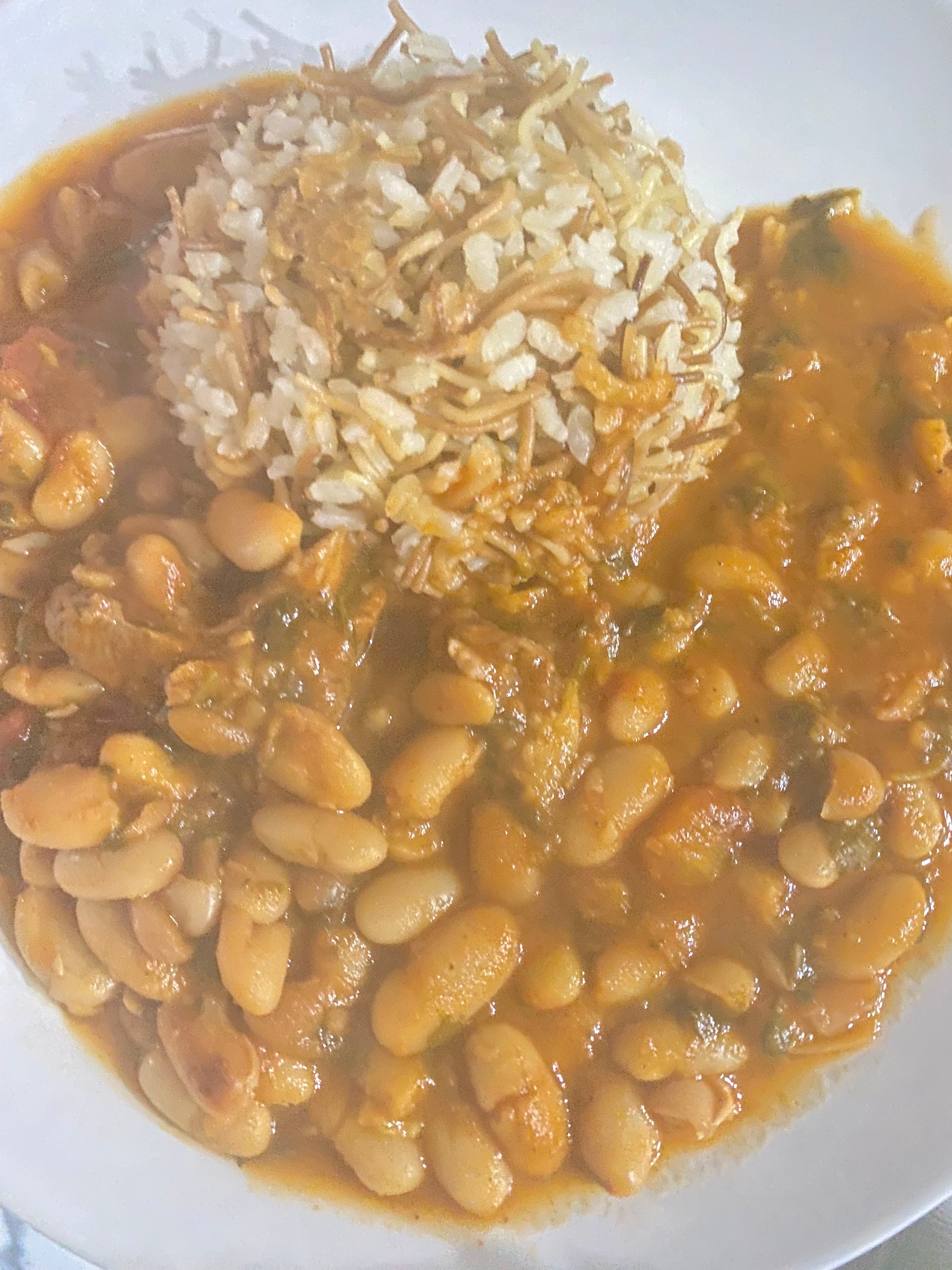
A comforting Lebanese white bean stew with lamb, tomato, coriander, and garlic served with fragrant rice and golden vermicelli.
Ingredients (Serves 4–6)
For the stew:
500g lamb cubes (shoulder or leg)
2 cups white beans (fasoulia snowbariyeh), soaked overnight or canned
3 tbsp olive oil
2 tbsp tomato paste
2 large tomatoes, grated or chopped
4 cups hot water or stock
Salt and pepper to taste
½ tsp cinnamon (optional, for warmth)
For the teklayeh:
6 cloves garlic, crushed
½ bunch fresh coriander, chopped
1 tbsp olive oil
For the rice with vermicelli:
1½ cups Egyptian rice
1 small handful vermicelli noodles
1 tbsp butter or olive oil
3 cups water
Salt to taste
Method
1. Prepare the lamb:
Place the lamb cubes in a pot with water, a pinch of salt, and aromatics of your choice (bay leaf, a few peppercorns, and a small piece of cinnamon stick if desired). Bring to a gentle boil and simmer until the lamb is tender (about 30–40 minutes). Reserve the stock for later.
2. Prepare the beans:
Soak the white beans (fasoulia snowbariyeh) for at least 6 hours or overnight. Drain and rinse, then place in a pot with fresh water and bring to a gentle boil. Cook until tender but not mushy (about 30–40 minutes).
3. Combine beans and lamb:
Once both the lamb and beans are tender, combine them in a large pot. Add the reserved lamb stock (or enough fresh stock to cover), tomato paste, fresh tomatoes, salt, pepper, and optional cinnamon. Simmer gently, allowing the flavours to meld for 15–20 minutes.
4. Prepare the teklayeh:
In a small pan, heat olive oil. Add crushed garlic and chopped coriander, sauté briefly until aromatic, then stir this into the stew just before serving.
5. Serve:
Serve the stew over rice with golden vermicelli, drizzle with olive oil, and enjoy warm.
Cook the rice with vermicelli:
In a saucepan, melt butter or oil and fry the vermicelli until golden brown. Add the rice, stir well to coat, then pour in the water and salt. Bring to a boil, cover, and simmer on low heat until the rice is fluffy and the water absorbed (about 15 minutes).
4. Serve:
Spoon the stew over rice, drizzle with olive oil, and enjoy warm with family.
In the end, yakhni is not just food. It is a vessel of care of mothers and grandmothers tending to their families, of traditions kept alive through ordinary days. It connects us to our past and sustains us in our present.
From the mountains of Lebanon to the kitchens of the diaspora, the stew continues to simmer steady, fragrant, and full of love.
Ohhh this week-end, I cooked yakhnit l fassolia. My stepmother cooked mloukhiyé.. I love all yakhni dishes 🤤🤤